Research reveals that executives below the top tier generate significant abnormal returns on company stock trades, highlighting hidden market dynamics.
Understanding the Dynamics of Insider Trading
Insider trading typically brings to mind high-profile figures such as CEOs or board members, whose transactions are closely monitored and required to be disclosed. However, a more nuanced examination reveals that executives operating beneath the top tier also engage in trading activities that warrant scrutiny. Research conducted by Hans K. Hvide and Kasper Meisner Nielsen delves into this phenomenon, uncovering substantial gains made by these lesser-known insiders.
Key Findings from the Research
Notable Returns on Company Stock
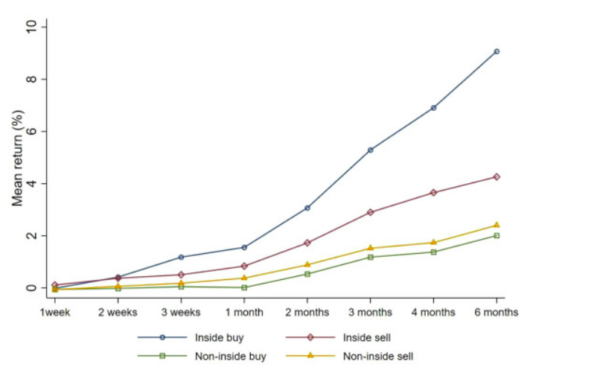
The analysis indicates that these mid-level executives achieve significant abnormal returns when trading their own company's stock. The study's findings suggest that returns range from approximately 68 to 101 basis points over one month, escalating to about 250 basis points over six months.
Underperformance in Unrelated Trades
Interestingly, the same executives do not exhibit similar success when trading stocks outside their own company. In fact, their trades in unrelated stocks generate negative abnormal returns, emphasizing that their success is likely rooted in access to internal information rather than general trading prowess.
Limitations of Industry Knowledge
The idea that expertise within a given industry compensates for poor performance in connections with non-company stocks is challenged by the data. Executives underperform even in trades involving other firms within the same sector, which rules out sector-specific knowledge as a driver of the abnormal returns they achieve on company stocks.
Top Executives Lag Behind
In a surprising twist, the research shows that top executives yield smaller or statistically insignificant abnormal returns compared to their lower-tier counterparts. This discrepancy may stem from the heightened visibility and regulatory scrutiny faced by top management, disincentivizing more aggressive trading based on informational advantages.
Non-Executive Employees Also Profiting
The insights extend beyond executives alone, revealing that non-executive employees typically enjoy similar trading advantages. The study notes that abnormal returns manifest across various wage categories, albeit more frequently among higher-paid employees who are likely to trade more often.
Persistence of Abnormal Returns
Another compelling finding is that the gains from insider trading do not vanish quickly. The benefits of these trades tend to accumulate over time, suggesting that insiders are not merely reacting to public information at a quicker pace but may be acting on valuable insights that the market gradually absorbs.
Indirect Trading Channels Have Limited Impact
The researchers also explored whether executives utilize family members or private companies to shield their trades. The evidence indicating abnormal returns through these methods is minimal, reinforcing the notion that most informed trading occurs through individual brokerage accounts.
Implications for Investors and Advisors
Broader Scope of Insider Trading
Investment advisors should be aware that insider trading extends beyond the transactions reported in public filings. Important trading activity may be occurring well below top management, demonstrating that valuable insights can be possessed by individuals who don’t fit the traditional mold of insiders.
Caution Against Overreliance on High-Profile Trades
Advisors should refrain from assuming that visible executive purchases are always indicative of future performance. Many of these transactions can be misleading if significant informational advantages reside with lower-tier management.
Market Efficiency Under Scrutiny
The sustained nature of the abnormal returns over several months raises questions about the speed at which the market integrates firm-specific information. This indicates a potential inefficiency that savvy investors might exploit.
Differentiating Information from Skill
This research reinforces the vital need for investors to distinguish between true investment acumen and advantages garnered from insider knowledge. Understanding this difference is crucial for prudent investment strategies.
Client Communication Strategies
“This study scrutinizes the trading behavior of executives below the top level within firms, revealing that they often profit significantly from insider trading. Utilizing comprehensive data from Norway spanning 1997 to 2014, the authors illustrate that these insiders earn substantial abnormal returns on their company stock purchases, while failing to outperform in trades outside their company or within the same industry. This suggests a widespread level of insider trading that extends beyond the usual spotlight on top executives.”
Visualizing Key Insights
This chart represents the average returns associated with trades conducted by lower-tier executives, detailing buy-and-hold returns after inside buys and sells as well as non-insider trades over various time horizons.
The displayed results are hypothetical and do not guarantee future performance while indicating market behaviors, not personal investor returns.
Research Abstract
Examination of insider trading laws reveals that regulatory oversight predominantly targets top executives, thereby allowing those below to operate relatively unnoticed. Analyzing Norwegian data on executives' stock purchases from 1997 to 2014 evidences substantial abnormal returns from these trades, with a stark contrast when assessing other stock trades, adding to the discourse on insider trading dynamics.
Insider Trading Insights: Profitable Moves by Lower-Tier Executives was originally published at Alpha Architect. For more information, please review the Alpha Architect disclosures.
Discussion
Sign in to join the discussion.