Digital payment systems enhance credit access significantly, especially for older and less educated consumers, while reshaping traditional lending criteria.
Digital payments are far more than just efficient transaction tools; they represent valuable data sources that can fundamentally alter credit markets. Each transaction provides insights into income stability, spending patterns, and overall financial behavior. Recent research reveals that cashless payment systems, particularly platforms like Alipay, have substantial implications for credit access in underserved populations.
Key Academic Insights
How Digital Payment Activity Increases Credit Access
A study conducted using proprietary Alipay data aimed to establish a causal link between cashless payments and consumer credit access. This investigation found that individuals engaging with digital payments, particularly through in-person transactions, enjoy a higher likelihood of receiving credit, along with larger credit lines. This is significant for understanding how payment data could reshape lending practices.
Isolating the Causal Effect of Payments
To mitigate concerns that frequent digital payment users might differ fundamentally from non-users, the research used a staggered rollout of Alipay-integrated bike-sharing services throughout various cities in China. This natural experiment allowed for a clearer analysis of the causal impacts of cashless payment adoption on access to credit.
Meaningful Impacts Post-Conversion to Digital Payments
The findings are striking: the adoption of in-person digital payment methods increases the likelihood of obtaining credit by approximately 56%. Among current credit users, a 1% growth in digital payment activity leads to about a 0.41% increase in their credit lines. Hence, the behavior associated with payment activity is becoming a critical factor in lenders' decision-making processes.
The Role of Payment Behavior Beyond Traditional Metrics
Unlike traditional lending practices that predominantly focus on repayment history, this research indicates that payment behavior itself is essential. Even after excluding transaction types tied to repayment, the positive correlation between payment volume and credit accessibility remains robust. This observation implies that lenders derive insights directly from consumer spending behaviors.
Targeted Effects on Underserved Groups
The research particularly highlights the positive ramifications for older and less educated demographics. These groups generally participate less in financial activities and often encounter more significant barriers to credit markets. The shift toward digital payments enables lenders to gather more comprehensive data on their behaviors, thus facilitating improved credit access.
Information Value vs. Collateral
Some may point to the idea that larger balances held within these platforms act as collateral that enhances credit access. However, the study contradicts this assumption by controlling for assets held on Alipay. The robust effects observed suggest that it’s the informational value of digital payment activity that primarily underlies the improved credit opportunities.
Consumer Spending Behaviour Insights
There are concerns that easier access to digital credit could drive harmful spending habits. However, analysis of transaction-level data indicates minimal evidence that consumers significantly increase expenditures on impulsive purchases following enhanced credit access. While overall spending does rise, it doesn't disproportionately affect high-risk spending categories.
Implications for Financial Advisors
Recognizing the Value of Payment Data
As digital payment systems become a prominent source of financial information, payment habits may increasingly supplement traditional credit scoring methodologies, especially for those with limited credit histories.
Competitive Advantages for BigTech
Companies controlling extensive digital payment platforms are likely to possess substantial informational advantages in consumer lending. Their access to real-time behavior data differentiates them from traditional financial institutions.
Potential for Growth through Financial Inclusion
The rise of digital payment adoption among underserved populations could open avenues for broader access to financial products such as loans, savings accounts, insurance, and investment opportunities, thereby enhancing long-term financial participation in emerging markets.
Awareness of Regulatory Risks
The very payment data that enhances credit access also brings to the forefront issues concerning privacy and algorithmic discrimination. Regulatory bodies are expected to increase scrutiny on how financial data is obtained and utilized.
Communicating to Clients
“Cashless payments do more than simplify transactions. Each digital payment provides insight into consumer spending behavior and income trends. This research shows that lenders can leverage this information to assess borrowers lacking traditional credit histories. As digital payments gain traction, especially in emerging markets, platforms like Alipay have the potential to broaden financial access for traditionally underserved consumers. Essentially, digital payments transcend mere transaction functions; they serve as information systems that can profoundly impact the landscape of credit markets.”
Quantitative Insights
The Most Important Chart from the Paper
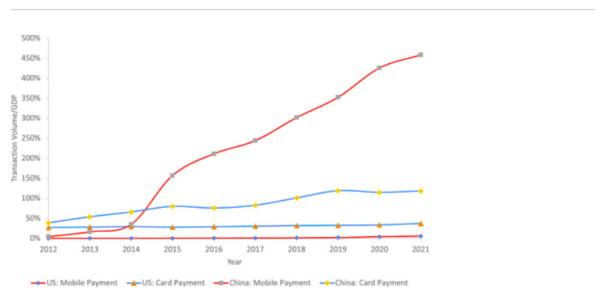
Figure 1 illustrates mobile payment penetration across various countries, showcasing GDP-adjusted transaction volumes per user alongside penetration rates from 2019 to 2023. Data sourced from Statista and the World Bank highlights the growth trajectory of cashless payments globally.
The results are hypothetical and not indicative of future performance; past performance does not guarantee future results.
Research Abstract
This paper examines the influence of cashless payment systems on credit accessibility within underserved populations through Alipay data. Utilizing the staggered implementation of bike-sharing services as a natural experiment, findings indicate that cashless payment adoption boosts credit access by over 56% and that a 1% increase in transaction flow enhances credit lines by 0.41%, with heightened benefits seen among less educated and older individuals.
Cashless payment and financial inclusion was originally published at Alpha Architect. Please consult the Alpha Architect disclosures for more information.
Discussion
Sign in to join the discussion.