A swift passenger and crew intervention thwarted a serious threat aboard a Flydubai flight, preventing a potential disaster during a mid-air crisis.
A Flydubai flight carrying over 170 passengers faced a critical situation when a pilot stabbed his colleague, attempting to crash the aircraft during its journey to Tel Aviv. Israeli Prime Minister Benjamin Netanyahu classified the event as a severe security violation. This incident raises both immediate safety concerns and broader implications for air travel security globally.
Incident Overview
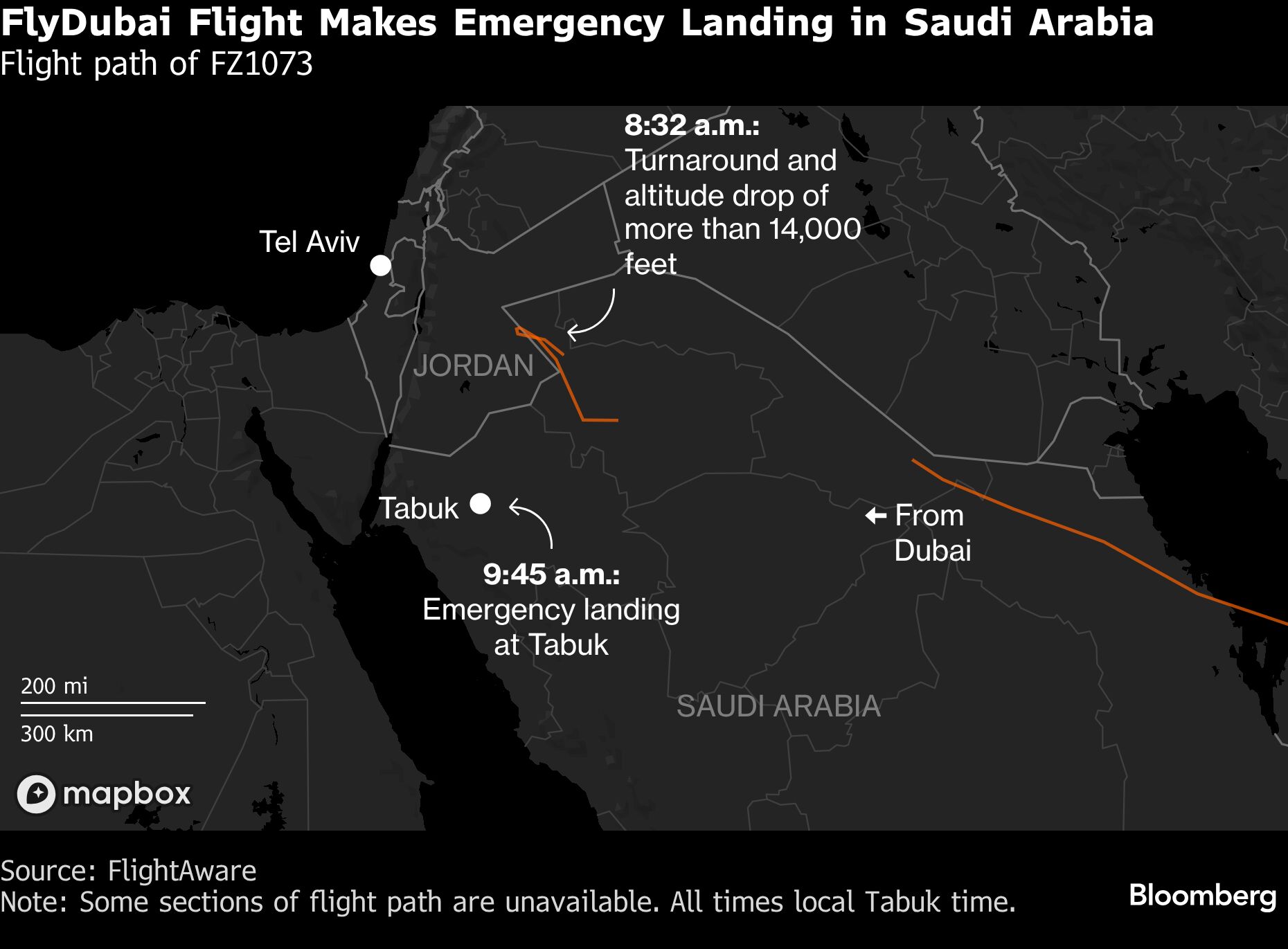
The incident unfolded shortly after takeoff from Dubai, as the plane suddenly lost over 14,000 feet (about 4,300 meters) in altitude within 30 seconds. Quick action by a passenger and crew members who rushed to the cockpit played a pivotal role in stabilizing the aircraft, averting what could have been a catastrophic crash. Eyewitness accounts from those onboard recount moments of sheer panic as the descent began. Passengers and crew alike demonstrated remarkable bravery under extreme pressure, functioning almost intuitively to neutralize the threat.
Prime Minister Netanyahu's assessment post-incident highlights the gravity of the situation. “They prevented a huge disaster,” he stated at a subsequent briefing. The aircraft, a Boeing 737, successfully made an emergency landing in Tabuk, Saudi Arabia, where the assailant is now under investigation by local authorities. The rapid response of those on board played a key role in averting what could have escalated into a major aviation disaster.
Flight Dynamics and Emergency Response
According to flight data from Flightradar24, the Boeing 737 began its alarming descent about two hours into the flight, issuing a general emergency call before later suggesting a potential hijacking. The technical aspects of this incident are noteworthy. The flight made a 180-degree turn after briefly entering Jordanian airspace, reflecting the pilots’ and crew members’ rapid decision-making to return to a safe haven in Tabuk.
After landing, images surfaced showing significant damage, including a missing rudder on the vertical stabilizer, suggesting the aircraft experienced substantial stress during its descent. This level of damage could point to drastic maneuvers made in response to the crisis, where every second counted in stabilizing the aircraft. The effectiveness of the cabin crew's training in crisis management is evident here, as emergency protocols clearly played a vital role.
Political Implications and Security Concerns
This incident occurs in a politically charged context, as Netanyahu approaches reelection with promises of enhanced security. While his opponents also prioritize safety, this crisis could sway undecided voters as a demonstration of real-time security challenges. It's interesting to consider how such incidents can impact elections, bringing security to the forefront of political discourse. In Israel, where security is a paramount concern, events like this undoubtedly become potent conversation starters, employing fear as a tool for political gain. What’s more alarming, however, is the reminder that such vulnerabilities exist in modern aviation.
Notably, most passengers were Israeli citizens, and Netanyahu praised the intervention of those onboard as an act of exceptional resourcefulness. “They saved many lives,” he emphasized. The distinction in his remarks suggests a recognition that not only did the passengers act heroically, but it also highlights the gravity of the situation, as many onboard were perhaps at greater risk due to their nationality. This nuanced acknowledgment adds a layer of complexity to the narrative, raising questions about how national identity can influence the discourse surrounding security violations.
Investigation and Future Outlook
Flydubai confirmed that the motivations behind the incident remain unclear and are under formal investigation. The ambiguity of the assailant's motives leaves room for speculation which could haunt the airline and the broader aviation industry. A repatriation flight has already successfully transported the passengers back to Tel Aviv, but the psychological scars from such incidents often linger longer than physical ones.
Typically, a Boeing 737 MAX 8 can carry around 174 passengers. Given the reported circumstances, the actions of those onboard likely staved off what could have been the most severe aviation disaster in over a year. Reflecting on this incident, one can't help but consider the balance airlines must strike between operational efficiency and passenger safety. While hijackings have become increasingly rare due to enhanced global safety protocols, Israel, which implements some of the strictest flight security measures, is particularly vigilant given its historical context involving attempted hijackings during the 1970s.
Moreover, while cases of pilot suicides are infrequent, they have occurred historically. Noteworthy examples include the 2015 Germanwings Flight 9525 incident and the still-mysterious disappearance of Malaysian Airlines Flight 370. The latter is widely thought to involve pilot involvement, highlighting persistent vulnerabilities in cockpit security. This underscores an ongoing debate within aviation circles about psychological screening and support for pilots—a crucial area that merits continuous attention.
Tabuk, located in northwestern Saudi Arabia, is near the Jordan-Saudi border, and Flydubai has stated that it is coordinating closely with local authorities regarding the next steps. An official from Israel’s transportation ministry reported that Emirati officials are actively working on repatriating passengers stranded in Saudi Arabia, as Israel’s Prime Minister promises all possible measures will be taken to ensure their safe return.
Lastly, Flydubai, a subsidiary of Emirates, commenced daily connections between Tel Aviv and Dubai in late 2020, growing its service to 70 flights per week, reflecting the burgeoning travel interest between Israel and the UAE. However, incidents like this can create reluctance among travelers, which could impact future bookings and necessitate enhanced security measures in the region. If you're working in this space, it's vital to recognize the potential for fallout that might arise from a single incident, altering the trajectory of aviation safety discourse for years to come.
Discussion
Sign in to join the discussion.