U.S. mutual insurers saw a remarkable increase in net income, reaching approximately $42.6 billion in 2025, driven by strategic underwriting adjustments.

Total net income for U.S. property and casualty mutual insurers skyrocketed to about $42.6 billion in 2025, marking a twofold increase compared to the previous year. This surge was primarily fueled by a transformation in underwriting income, which rebounded to approximately $14.8 billion, recovering from a loss of $7.2 billion in 2024.
Overview of Recent Performance
The considerable increase in net income signals a period of recovery and resilience within the mutual insurance sector. After a challenging year marked by significant underwriting losses, the sector appears to have capitalized on improved market conditions. A surge in underwriting income contributes significantly to the industry's overall performance, setting a stark contrast to the prior year's figures. Historically, mutual insurers have had varied cycles of profitability affected by external factors including economic downturns and an increasing prevalence of natural disasters.
A recent report by A.M. Best highlights that a slight 2% decline in loss and loss adjustment expenses contributed to this increase, despite underwriting expenses seeing a 5.8% rise in 2025 compared to 2024. The juxtaposition between declining loss costs and rising operational expenses suggests a general tightening of underwriting practices that may help restore profitability. Without question, the mutuals' strategies are evolving in response to intense competition and changing risk profiles.
Strategic Adjustments in Underwriting
“Mutuals began filing for significant rate increases, restructuring discounts, and raising deductibles in prior years, and these underwriting strategies have now started to pay off,” said Justin Aimone, a financial analyst at A.M. Best. His observations underscore a shift not just in pricing but in the overall risk approach taken by mutual insurers. The role of data analytics and risk modeling is impossible to overlook; these technological advancements empower insurers to make better-informed decisions about pricing and risk acceptance, leading to improved financial outcomes.
Impact of Severe Weather and Underwriting Adjustments
The report emphasizes that mutual insurers have proactively adjusted their pricing strategies to respond to the growing frequency and severity of secondary perils, including convective storms, wildfires, and flooding. In 2025, the industry faced 23 natural disaster events that each resulted in economic damages exceeding $1 billion. This statistic illustrates the mounting challenges insurers face, and yet the absence of a significant hurricane event allowed insurers to implement their underwriting adjustments effectively. Integrating these adjustments smoothly into pricing has proven beneficial, contributing to the improved financial outcomes being reported.
Still, 2025 stands as the third-highest year for billion-dollar weather disasters in recorded history. If you're working in this space, these data points should give you cause to contemplate the lasting impact of climate change on risk assessment models and insurance pricing. Given the patterns, anticipation of future losses may require mutual insurers not just to raise rates but to re-evaluate how they categorize and price risks associated with evolving weather patterns.
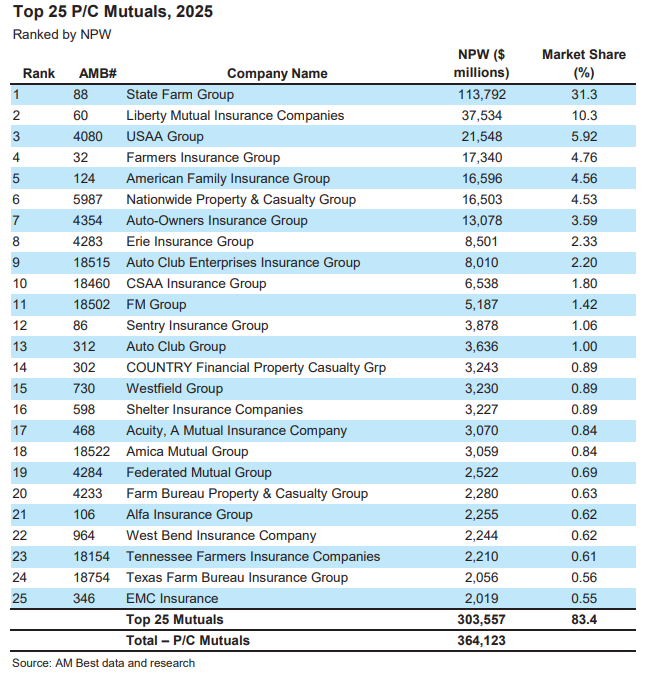
A.M. Best indicates that premiums have finally aligned with claim costs. However, rate increases and premium growth displayed signs of moderation in 2025. Net premiums written increased by about 5%, reaching $364.1 billion, returning to pre-pandemic averages. While these numbers signal recovery, they also present an opportunity for caution. Prolonged moderation could reflect a market that's either stabilizing or struggling to capitalize on growth opportunities presented by a still-recovering economy.
Improved Financial Ratios
The combined ratio for mutual insurers significantly improved to 95.2 in 2025 from 101.2 in 2024 and 110.4 in 2023, showcasing effective management in underwriting practices. The trend toward a healthier ratio indicates that these companies are becoming more capable of covering their costs associated with claims and operating expenses. Although the five-year average for the combined ratio is closer to 104, the progression toward a sub-100 figure stands as a noteworthy achievement that reflects positively on the sector's resilience.
Interestingly, the hierarchy among major mutual insurers remains consistent, with the top 25 companies together accounting for over 83% of total net premiums written from mutuals. This concentration points to a marketplace with a high degree of stability and dominance by a few key players. Such market dynamics can present both opportunities and risks; while these leading firms might benefit from economies of scale, there’s always the underlying risk that shifts in market conditions can disproportionately affect the largest players.
Future Outlook and Implications
So where does this leave mutual insurers? The current data reflects potential stability, but reliance on underwriting improvements may not be sustainable. As severe weather events become more unpredictable, the pressure on rates and premium growth could soon emerge again. Moreover, the industry’s response to these challenges will define its future trajectory.
What this means for you, whether you're a stakeholder or an analyst, is that careful attention must be paid to ongoing trends in claim costs and premium structures. Adjustments in personal lines and commercial insurance products will likely lead the way as competition persists. Looking ahead, the industry's ability to adapt its risk appetite and pricing structure will be vital as it faces an increasingly hostile environment for natural disasters. The question remains: can mutual insurers sustain their profitability amid heightened risks without alienating policyholders?
In summary: the recent performance metrics are promising, but vigilance is key. The mutual insurance industry stands at a crossroads, balancing operational efficiency against a backdrop of evolving risks. The next phase involves not just surviving financial challenges but thriving amidst them. A nuanced approach will be needed to navigate this complex reality.
Discussion
Sign in to join the discussion.