Ken Griffin's $2 billion investment to bring Carnegie Mellon University to Miami aims to reshape the city into a technology and finance hub.
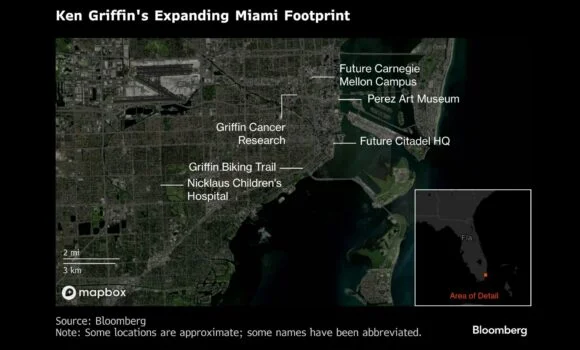
Ken Griffin is orchestrating a transformative vision for Miami, seeking to transition the city from a luxury playground into a prominent center for finance and technology. A cornerstone of this plan is his substantial $2 billion investment to establish a Carnegie Mellon University campus in the Wynwood neighborhood, which Griffin believes will catalyze Miami's economic evolution.
"The magnitude of this gift represents the magnitude of the aspiration," Griffin shared in an interview, emphasizing the potential impact of the university as a breeding ground for engineering talent. His objective? To prepare students for careers at Citadel or to inspire them to launch businesses that will attract further investments to South Florida, thereby enhancing both local and national prosperity.
Griffin's commitment to Miami has recently intensified since his departure from Chicago in 2022, where he established Citadel. He is in the process of building an unprecedented headquarters for the firm, complete with a sprawling family estate on Star Island and amenities including a private marina for his yachts. His philanthropic footprint has rapidly expanded across Miami, characterized by significant contributions to various institutions such as the Kenneth C. Griffin Center at Baptist Health Miami Neuroscience Institute and the Pérez Art Museum, highlighting his strategic intent to embed himself within Miami's elite circles.

His philanthropic contributions also extend to significant investments in the University of Miami and Nicklaus Children’s Hospital, manifesting a comprehensive strategy to reshape education and healthcare in the area. By bringing CMU to Miami, he aligns himself with historic benefactors who significantly impacted cities across the U.S. during the Gilded Age.
Griffin sees great universities as pivotal to fostering an environment where young professionals want to build their futures. Yet, transforming Miami into a flourishing business hub comes with formidable challenges. Rising housing costs due to an influx of affluent newcomers, concerns over climate change, and inadequate public infrastructure are just a few of the hurdles. There’s also the added complexity of Florida's shifting educational landscape under Governor Ron DeSantis, which raises concerns about the intellectual climate within the state.
Urban planning expert Mitchell Moss argues that Griffin faces an uphill battle, stating, “Ken Griffin is making a bet that a new university can overcome what is basically a hostile environment for intellectual freedom and creativity.” This skepticism reflects broader unease about whether Miami can become a viable educational focal point amid such a volatile backdrop.
In a bid to amplify Miami's potential, Griffin has partnered with billionaire developer Stephen Ross. Together, they are advocating for South Florida as a burgeoning hub for economic growth, hoping to sway business leaders to invest in the area. Their joint efforts have included a $10 million campaign intended to showcase the region as the nexus for future opportunities.
However, persistent issues plague the city, from limited access to top-tier private schools for the elite class to long waiting times at exclusive clubs. Miami's densely populated region suffers from notorious traffic congestion and inadequate public transit options. To confront these collective challenges, Griffin co-founded the Partnership for Miami, an initiative designed to tackle the city’s pressing economic issues.
Ned Murray, director of the Metropolitan Center at Florida International University, notes the unique complexities of economic development in Miami, stressing the need for a paradigm shift: “We’ve got to do better.” As Griffin's ambitious plans unfold, stakeholders across sectors will need to navigate both the potential rewards and the obstacles that could impede Miami's ascendancy as a global player in finance and technology.
–With assistance from Amanda Gordon and Janet Lorin.
Discussion
Sign in to join the discussion.