Mortgage applications fell 9.7% in early January, reflecting seasonal adjustments and shifts in refinancing, even as rates dropped to 6.25%.

Mortgage applications took a notable downturn, decreasing 9.7 percent in the first week of January 2026 compared to the prior fortnight, as reported by the Mortgage Bankers Association (MBA). This data reflects seasonal adjustments for the holiday period.
Key Indicators
The MBA's Market Composite Index, which gauges mortgage loan application volume, witnessed a decline of 9.7 percent on a seasonally adjusted basis. When not adjusted for seasonality, the Index's decrease was markedly sharper at 28 percent. This discrepancy underscores the seasonal influences on the market; it's common to see dips in activity immediately following the holiday season as potential homebuyers and those looking to refinance step back from the market. The Refinance Index, adjusted for seasonal variations, dropped by 14 percent compared to two weeks prior, though it noted an astonishing 133 percent rise when viewed year-over-year. This suggests that while current conditions may be sluggish compared to the immediate past, they represent a recovery from a much weaker market position a year ago. In contrast, the unadjusted Refinance Index fell by 31 percent but remained 108 percent higher than the same week last year. Such year-over-year comparisons paint a more favorable picture of the refinancing landscape, hinting at potential resilience among borrowers.
Additionally, the seasonally adjusted Purchase Index experienced a 6 percent decline from the previous period, while the unadjusted Purchase Index fell by 23 percent. Yet, despite this recent downturn, the Purchase Index still maintains a 10 percent increase year-over-year. This scenario illustrates that even though the holidays typically suppress activity, there's an underlying demand that's yet to be fully realized within the market. If you’re working in this space, it’s essential to recognize these indicators as reflective of varying buyer sentiment rather than pure market weakness.
Market Rate Developments
Joel Kan, the MBA’s Vice President and Deputy Chief Economist, pointed out that mortgage rates started the year at 6.25 percent, which is noteworthy as it represents their lowest point since September 2024. In many ways, this figure acts as a psychological benchmark for potential homebuyers. Although refinancing applications rose by 7 percent week-over-week, that increase was slower than what was observed in the lead-up to the holidays. This slowdown could indicate that many homeowners have already locked in lower rates in prior months, leading to diminished urgency for refinancing now.
Interestingly, the Federal Housing Administration (FHA) segment saw a significant bounce with a 19 percent jump in refinance applications, partially recovering from a steep drop the previous week. This rise is particularly relevant, considering FHA loans often cater to first-time homebuyers who might be more sensitive to rate changes, reflecting shifting dynamics in the lower end of the market.
Purchase Applications and Loan Sizes
While total purchase applications were 10 percent higher year-over-year, the recent dip following declines in both conventional and FHA applications hints at a potentially turbulent market ahead. It suggests a cautious approach among buyers who may be waiting for more favorable conditions before committing to new loans. The average loan size also fell to $408,700, marking the smallest figure in twelve months. Lower average loan sizes in both conventional and government-backed categories suggest a trend where affordability challenges are pushing buyers toward less expensive properties, or perhaps even reducing the size of the homes they're seeking altogether. This is more significant than it looks; if these trends persist, they could reshape market demands in the near future.
The average contract interest rate for 30-year fixed-rate mortgages with conforming loan balances decreased slightly to 6.25 percent from 6.32 percent, with points lowering to 0.57 from 0.59 for loans carrying an 80 percent loan-to-value ratio. This slight decrease in rates, paired with the declining average loan sizes, indicates a market adjusting not only to broader economic conditions but also to the realities of increasing home prices that have far outpaced wage growth in recent years.
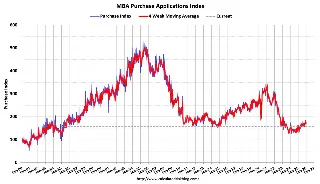
Click on graph for larger image.
The MBA indicates a 10 percent year-over-year increase in unadjusted purchase activity, highlighting a recovery from the lows experienced in 2023. However, as the recent figures signal volatility, the market remains cautious while navigating these fluctuations, demonstrating the tension between buyer intent and external economic factors. (And this is the part most people overlook.) Consumer confidence plays a pivotal role; with uncertainty in the broader economy, many prospective homebuyers could be rethinking their purchase timelines.
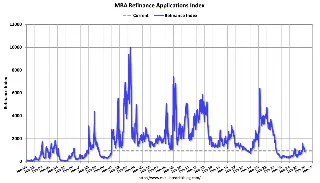
The refinance index has seen a rebound since the drop in rates, yet it stands lower than the peak figures recorded in September. This reflects a market adjusting to rate stability, which often tends to reduce the urgency for refinancing as borrowers become comfortable with current rates. As we monitor these indicators in the coming weeks, it becomes increasingly clear that the ongoing interplay of market fluctuations and borrower sentiment will shape the mortgage market's trajectory.
Future Outlook: What Lies Ahead?
The outlook for mortgage applications in early 2026 is neither bleak nor overly optimistic. While some trends suggest a recovery from previous lows, others point to potential headwinds that could stymie growth. As interest rates stabilize, one may expect a more consistent flow of refinancing activity. However, should economic uncertainties persist, buyers might hesitate, impacting purchase applications adversely.
The delicate balance between rising rates, inflationary pressures, and buyer affordability will ultimately dictate the mortgage market's fate in the coming months. If trends from previous years hold, expect further fluctuations, with potential increases in demand as rates either stabilize further or begin to dip again. The rise in FHA loans could signal shifting demographics too, indicating a broader trend where first-time buyers are increasingly leveraging government-backed products to enter the market, albeit with caution.
Discussion
Sign in to join the discussion.