Job openings in the U.S. fell to 7.1 million in November, indicating potential stabilization in the labor market amid unchanged hiring rates.

The U.S. Bureau of Labor Statistics reported that job openings decreased slightly to 7.1 million in November, down from 7.45 million in October. This decline reflects a year-over-year drop of 11%, indicating a cooling in demand for labor. Such fluctuations in job openings can often signal shifts in economic confidence amongst employers and employees alike. A reduction in available positions can reveal underlying trends in sectors experiencing contraction or adjustment in hiring strategies. In industries where growth is pivotal, these trends can foster concerns about workforce stability and economic resilience.
Labor Market Activity
In November, both hiring and total separations remained stable at 5.1 million each. This stability suggests that while job openings are decreasing, the overall labor market is maintaining a consistent hiring pace. The numbers can be interpreted as a juxtaposition; companies may be reining in their hiring ambitions while also maintaining their current workforce levels. A healthy balance is often sought in labor dynamics, but any marked changes in either direction can lead to significant consequences for economic health.
While stable hiring figures indicate a degree of confidence, the overall decrease in job openings may raise flags about future employment prospects. Hiring often reflects an expansionist mindset within companies, while stable separations may suggest job security or complacency in existing roles. If you're working in this space, you'll want to keep an eye on these trends; they can have far-reaching effects on wage growth and labor mobility.
Details on Separations
Among separations, voluntary quits totaled 3.2 million, marking a 4% year-over-year increase. This statistic suggests a certain level of employee confidence in the labor market, where individuals feel empowered to leave jobs in search of better opportunities. Interestingly, layoff and discharge numbers held steady at 1.7 million, showing no significant change. The relatively static nature of layoffs indicates that while firms may be cautious with hiring, they're not aggressively cutting back on their workforce, either. Some sectors may even be viewed as a safe harbor amid economic uncertainty, allowing employees to take risks in their career pursuits.
This dynamic can also hint at a broader issue: a mismatch between available jobs and candidate skills. If employees are quitting in search of better opportunities but the job market isn't expanding to accommodate newer positions, you could see an escalation of frustration across industries. Furthermore, it raises the question of whether employer expectations have morphed beyond realistic contours, prompting skilled workers to seek employment elsewhere.
Trends and Insights
The relationship between job openings and total separations highlights the current state of the labor market. When the number of hires surpasses separations, it indicates net job creation. Conversely, a rise in separations or a drop in hires could signal job losses. This functional interpretation is vital for economists and policymakers alike as they try to gauge economic health through labor metrics.
At a macroeconomic level, these labor statistics can serve as indicators of economic confidence and the prospective direction of growth or contraction. The net increase in quit rates amid a backdrop of lessening job openings suggests that while employees may be feeling more confident to pursue new paths, the companies may not be in a position to accommodate that ambition as fervently as before. Reduced openings in conjunction with stable separations might reveal companies are planning ahead, but this could easily backfire if the economy does not respond positively.
While job openings serve as a critical signal, you'll want to consider how external pressures, like inflation or geopolitical tensions, could affect hiring behaviors in the coming months. Consider this: if employers tighten their belts amid economic uncertainty, we might see a shift that leads to downward pressure on wages as competition for available jobs increases.
Looking Ahead: Implications and Significance
This report focuses on November’s data; the forthcoming employment report will cover December's statistics for a more comprehensive view of the labor market's trajectory. It's worth considering how political decisions, such as economic stimuli or regulatory changes, might create new openings or, alternatively, lead to stagnation in hiring. The interplay between job openings and separations not only affects employees and employers but frequently reaches into broader economic indicators, influencing inflation, consumer spending, and even housing markets.
As we look ahead, the implications of these trends extend beyond immediate hiring decisions. For instance, persistent decreases in job openings could reflect an impending slowdown in economic growth, potentially heralding recession concerns. The employment market's current temperature hints at a cautious approach by employers, one they may carry into the new year as uncertainty lingers.
Ultimately, as companies navigate these unpredictable times, attention to labor market dynamics will be paramount. Those invested in sectors dependent on workforce availability must adjust with agility to effectively respond to evolving conditions. Layoffs, the current quit rate, and hiring patterns will be focal points not just in December but for the foreseeable future. Be prepared; the road ahead may be rocky.
Job Openings and Labor Turnover Summary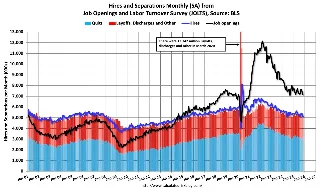 Click on graph for larger image.
Discussion
Sign in to join the discussion.