FEMA denials and delayed reimbursements are increasing local recovery burdens, while schools, libraries and faith groups help communities respond.
Disaster recovery now carries a greater financing risk for local governments: federal assistance may be denied, and reimbursements for work already completed can remain outstanding. As that uncertainty grows, schools, libraries, churches and other community institutions are taking on more of the immediate response and support that federal dollars have traditionally helped sustain.
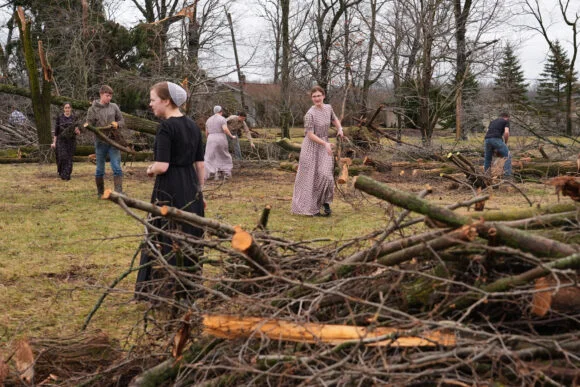
The pressure became visible in Michigan in March 2026, when four tornadoes swept across the southwest of the state and killed four people. Gov. Gretchen Whitmer sought Federal Emergency Management Agency assistance for uninsured and underinsured losses. FEMA rejected the request and then rejected her appeal. In Union City, where an EF3 tornado killed three people, neighbors and local organizations began providing help within hours.
Federal decisions shape local exposure
The Michigan denials came amid a marked rise in rejected disaster declarations. The Trump administration denied 26% of major disaster declarations in 2025, more than twice the rate recorded the year before and above the 15% average over the preceding two decades.
Research examining roughly 2,500 disaster declarations since FEMA was created in 1979 found a pronounced difference in outcomes during President Donald Trump’s second term. Among states where the governor and both U.S. senators were from the same party, nearly 90% of requests from all-Republican states were approved, compared with 23% from all-Democratic states. The White House has denied that politics affects disaster aid decisions.
Other comparisons point in the same direction. Andrew Rumbach, a senior fellow at the Urban Institute, analyzed FEMA data and found that about 84% of requests from states Trump won in 2024 were approved during his second term, versus about 42% from states he lost. Colorado, an all-Democratic state, had both of its 2025 appeals denied, the state’s first such denials since the 1980s.
Florida received a different outcome. In June, Trump announced $416 million for the state’s disasters, without identifying a specific event, and said much of the money would go to the Panhandle, one of his “favorite places.” A snowstorm in the Panhandle in January 2025 was linked to 13 deaths and caused an estimated $200 million in damage.
For municipal budgets, the consequences of a denial can be immediate. Local governments may have to absorb recovery expenses that reach 15% of an annual budget. FEMA also owes local governments almost $10 billion in reimbursements for recovery work they have already paid for. Philanthropies and groups such as Team Rubicon are widening their role, but they cannot replace federal funding at that scale.
Local networks fill the first gap
Union City’s response shows what those networks can do before outside aid arrives. The local high school became a shelter on the night of the tornado. Volunteers brought food and supplies, while the United Way opened a relief fund. Donations went to the school, and its staff coordinated distribution to residents. A church damaged in the storm set up a fund to help people cover insurance deductibles.
Residents are typically the first to respond after a disaster. What made Union City’s experience different was that federal assistance did not follow. Local institutions could organize practical help quickly, but their capacity depended on volunteers, donations and the resources already available in the community.
The recovery after Hurricane Katrina offers another example of the value of a trusted local institution. In August 2005, floodwaters reached 12 feet (3.6 meters) in the low-income neighborhood around Mary Queen of Vietnam Church in eastern New Orleans. By summer 2007, about 90% of the neighborhood’s residents had returned, compared with 45% across New Orleans. The church’s Rev. Vien Nguyen coordinated supplies and volunteers and kept residents in touch as they evacuated to other states.
Community spaces support resilience
Research by Daniel P. Aldrich, Dean’s Professor of Resilience at Northeastern University, has examined how social ties affect communities during emergencies. A study of U.S. counties during the COVID-19 pandemic found that, after accounting for politics, governance, health care quality and demographics, two kinds of relationships were associated with a lower toll: ties among family members and neighbors, and connections between residents and public officials.
Schools, faith organizations and libraries can help build both kinds of ties because people already gather there. Libraries also provide practical shelter during extreme temperatures. In 2025, 44.7% of U.S. public libraries served as cooling or warming centers, an increase of 8.2% from 2022.
Many libraries, however, have limited preparation for emergencies. A national survey found that 84% of library directors considered disaster response a critical library role. Only 36% knew federal law allows libraries to seek FEMA relocation funding to move to safer ground, and 51% said their library had an emergency preparedness plan.
The distribution of federal disaster spending offers a further measure of the gap. Aldrich writes that more than 90% of federal disaster funds went to roads, utilities and other standard infrastructure in the early 21st century, while less than 10% went to libraries, parks, schools, places of worship and community centers. Federal aid can support rebuilding some of these facilities, but it rarely covers the cost of keeping them open and operating during the period when residents need them most.
Recovery capacity depends on what stays open
A study of Japanese communities found that those with more social infrastructure had half as many deaths during the catastrophic tsunami of March 2011 as similar communities with fewer gathering places. The finding adds to evidence that community spaces can contribute to resilience, alongside the roads, utilities and other physical assets that dominate disaster spending.
For local governments, the financial issue is not simply whether aid eventually arrives. It is whether a community can fund urgent response, keep essential gathering places functioning and manage recovery expenses while federal decisions and reimbursements remain uncertain. Schools, libraries and faith groups can coordinate residents and make help easier to reach, but they operate with finite resources.
The communities best positioned to recover may be those that have sustained these institutions before disaster strikes: keeping libraries open, civic halls available to volunteers and public spaces in regular use. Their contribution is difficult to measure as a line item, yet the evidence suggests that the connections formed there can shape both the speed and strength of recovery.
This article is republished from The Conversation under a Creative Commons license. Read the original article here.
Top Photo: Volunteers work to clear branches after a suspected tornado hit the area a day earlier in Union City, Mich., Saturday, March 7, 2026. (AP Photo/Nam Y. Huh)
This article is republished from The Conversation under a Creative Commons license.
Discussion
Sign in to join the discussion.