Golf ball sized hail damaged vehicles in metro Phoenix, while winds up to 70 mph and heavy rain hit communities north of the city.
Arizona’s latest round of severe weather brought vehicle damage across metro Phoenix and stronger impacts farther north, underscoring the region’s exposure to occasional high loss events. Wednesday’s storms produced golf ball sized hail in the Valley, with reports of shattered windshields, while gusts reached 60 mph across the metro. Those conditions put cars, homes and trees under strain at the same time, making the storm’s effects broader than a hail report alone might suggest. A vehicle can be damaged by direct hail strikes, debris carried by wind, or a falling branch; the reports from the Valley describe more than one of those hazards.
Damage spread across the Valley
North Phoenix, Glendale, Tempe and Mesa were among the areas hardest hit by hail. Shattered windshields offer a visible measure of the storm’s force, though they don’t capture the full scope of possible vehicle damage. Hail can leave dents and damage glass across a wide area, and the extent of repairs depends on where a vehicle was parked and how exposed it was. That variation can make damage assessment uneven even between nearby neighborhoods.
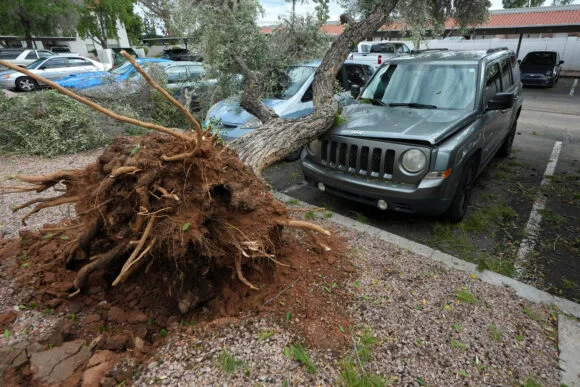
Strong winds also brought down trees, including one that fell onto vehicles at an apartment complex in Mesa. The incident shows how wind damage can compound hail damage: a car may be exposed to both falling debris and airborne material during the same storm. For residents, the practical challenge is establishing what was damaged and documenting it while conditions are still fresh. For insurers, a storm affecting multiple communities can mean many separate claims, with the cause and extent of damage differing from one vehicle or property to another.
The storm’s most severe conditions passed north of Phoenix. Communities near Prescott and Flagstaff reported extensive damage from winds reaching 70 mph and heavy rainfall, while Overgaard, in Navajo County, sustained heavy wind damage. Those reports point to a wide footprint, but they don’t mean every community faced the same conditions or losses. Local reports raised the possibility of a tornado; the National Weather Service had not confirmed that one occurred. That distinction matters: a reported possibility is not a confirmed event, and the available information doesn’t establish a tornado as the cause of the damage.
Severe weather has a costly precedent
Hail is uncommon in Phoenix, though the metro has seen several severe storms over the past year. A November 2025 storm brought hail to the West Valley. Earlier, successive hailstorms in October 2010 caused an estimated $2.7 billion in insured losses in Phoenix, a reminder that infrequent events can still produce substantial claims. The 2010 figure gives the current damage a useful historical frame, but it shouldn’t be treated as a forecast for this storm: the source provides no estimate of losses from Wednesday’s weather.
Here’s the thing: rarity can make a hazard easy to underweight until it reaches a particular neighborhood. A storm doesn’t need to be common to become costly, especially when hail and high winds affect vehicles and buildings across a broad area. At the same time, a dramatic precedent can distort expectations if readers assume the same scale of damage will recur. The present reports establish that vehicles were damaged and that several areas faced severe conditions; they don’t yet quantify the total claims or show how Wednesday compares with the 2010 storms.
This is more significant than it looks. The storm’s effects weren’t confined to one kind of damage or one part of Arizona: the Valley saw hail and strong gusts, while communities farther north reported heavier impacts from wind and rain. That spread complicates any simple account of the event. A single storm system can create very different repair needs from place to place, and early reports may not capture every affected property.
What the reports can—and can’t—tell us
For insurers and vehicle owners, the immediate focus is assessing damage from a storm system that affected communities across a wide area, with hail, falling trees, heavy rain and high winds. Assessment is a process, not a single headline number. Claims teams generally need to distinguish among different types of damage and establish which properties were affected; owners, in turn, may be trying to determine whether visible damage is limited to glass or extends to the vehicle’s body. The source doesn’t provide claim totals, repair costs or a count of damaged vehicles, so any estimate of the storm’s financial impact would be premature.
If you’re working in this space, the split between reported damage and confirmed findings deserves attention. The possibility of a tornado near some affected areas has been raised, but the National Weather Service had not confirmed one. That leaves the reported wind and rain as the clearer account of conditions available here. Careful wording matters when the event is still being assessed, particularly because a confirmed cause can shape how the public understands damage reports.
And yet, the lack of a loss estimate doesn’t make the event economically trivial. Multiple forms of damage across a broad area can create a substantial burden for households and insurers, even before the final scope is known. The historical losses show why Phoenix’s occasional hail events command attention; they don’t tell us what this storm will cost. Still, the pattern is a reminder that uncommon weather can have a very ordinary consequence: repair bills.
Near-term outlook
Dry conditions are expected across most of Arizona in the coming days. That forecast offers a change in immediate weather conditions, but it doesn’t resolve the work left by the storm. Damaged vehicles still need inspection, fallen trees and other debris need attention, and reported impacts need to be assessed across the affected communities. The source gives no estimate for how long that process will take.
For now, the clearest reading is measured: the Valley experienced hail and damaging gusts, areas farther north saw stronger reported impacts, and the tornado possibility remains unconfirmed. The 2010 losses explain why even infrequent storms can carry serious costs, but the current event’s financial scale remains unknown. A broad footprint. That’s the part that will matter as damage reports are assembled.
Top photo: An uprooted tree damaged vehicles at a local apartment complex after storms hit, Wednesday, Oct. 21, 2026, in Mesa, Ariz. (AP Photo/Ross D. Franklin)
Discussion
Sign in to join the discussion.