HSBC’s Georges Elhedery says new Gulf energy routes could reduce reliance on Hormuz within five years, amid a sharp regional growth downgrade.
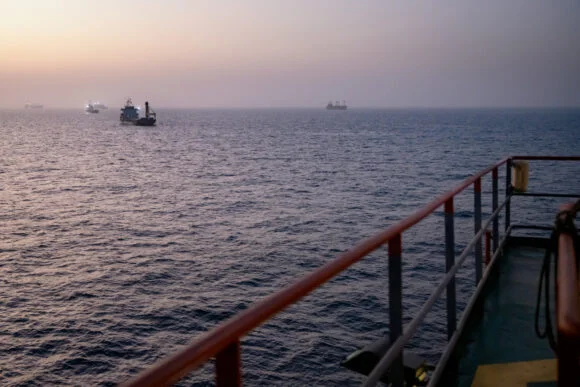
The Iran war has put a price on the Gulf’s reliance on the Strait of Hormuz—and, in HSBC Group CEO Georges Elhedery’s view, could accelerate infrastructure spending that changes the region’s energy routes. He said investment in pipelines linking producers to ports may make Hormuz “redundant” within five years. That’s a bold forecast, and it depends on much more than announcing projects: routes need to be built, connected to export facilities and capable of carrying meaningful volumes. The claim is best read as a view about the direction of investment, not evidence that the strait is about to lose its role.
Infrastructure plans gain urgency
Before the conflict, roughly one-fifth of global oil and liquefied natural gas trade passed through the strait. That concentration makes Hormuz a strategic chokepoint: disruption there can affect energy flows well beyond the countries that border it. Alternative routes could give producers more options when shipping conditions are uncertain, but pipelines and ports can only reduce exposure if they connect supply to buyers at useful scale. A route on a project plan doesn’t move a barrel of oil or a shipment of gas.
Gulf states are now directing resources toward alternative routes, a shift Elhedery said could help the region absorb the economic fallout and keep growing. The logic is straightforward: infrastructure investment can support activity during a period of weakness, while new transport capacity may give exporters greater flexibility over time. The timing, though, matters. Spending can take years to turn into operating assets, and the region’s immediate economic pressure may arrive before the benefits of completed projects.
“We do see this region being able to recover and then continue growing. It will mean a lot of investment,” he said Tuesday at the HSBC Future Forum in Dubai. He also said he hoped the conflict would be resolved. His comments combine a long-term case for investment with an acknowledgment that the conflict’s outcome remains unsettled. That distinction matters: confidence in the region’s capacity to recover isn’t the same as certainty about when recovery will begin.
The proposed spending pipeline is substantial. HSBC cited MEED data showing $872 billion in individual project packages across the Middle East, North Africa and Turkey, within a broader $1.4 trillion pipeline of planned projects that have not yet been awarded. Those figures indicate the scale of potential activity; they don’t establish how much capital will be committed or when projects will be completed. A package in a pipeline can still face decisions about funding, scope and timing before construction starts.
Here’s the thing: the headline figures describe opportunity, not finished infrastructure. For the Hormuz thesis to hold, the region would need functioning links between producing areas and ports, alongside the capacity to handle and ship the output. Those pieces have to work together. (And this is the part most people overlook.) A pipeline that reaches a port doesn’t by itself prove that exporters can reroute enough trade to make the strait redundant.
Investment confidence meets a weaker outlook
HSBC’s survey of more than 1,600 business leaders and about 820 institutional investors found that respondents continued to view the Gulf as an attractive investment hub. That sentiment sits alongside a markedly weaker near-term forecast: after 3.3% growth in 2025, the World Bank projected a 1.3% contraction this year for the Middle East, North Africa and Pakistan region because of the war. It expects a strong but uneven recovery in 2027.
The contrast is a reminder that investor interest and current economic performance measure different things. Survey respondents can see long-term potential in a region while businesses face immediate disruption and weaker demand. The World Bank’s forecast gives the near-term risk a sharper edge: a projected contraction means the expected recovery would follow a period of economic strain, and its uneven character suggests that gains may not be shared evenly across countries or industries.
Still, the survey doesn’t establish how much investment will arrive, or whether respondents’ views will translate into awarded projects. Sentiment is one input into business decisions; funding, execution and conditions on the ground also matter. The numbers here are underwhelming as a near-term story, even if the project pipeline points to a larger ambition. If you’re working in this space, the useful distinction is between expressed confidence and committed capital.
Elhedery was among the global financiers expected at Saudi Arabia’s flagship investment conference next week. Organizers postponed the event to 2027 on Monday after deadly strikes in Riyadh by Yemen’s Iran-backed Houthis. The postponement is a concrete sign of how the conflict is affecting business activity and planning. It also sits uneasily beside forecasts of investment-led growth: major projects and conferences depend on conditions that can change quickly.
What the five-year forecast depends on
Elhedery’s five-year timeline puts the focus on execution. Similar infrastructure programs typically require coordination among producers, transport networks and export facilities, and their usefulness depends on the capacity available at each link. The source gives no project-by-project completion schedule, so it doesn’t show whether enough alternative capacity could be operating within that period. Five years may be enough for meaningful changes, but the claim can’t be verified from the pipeline total alone.
Nor does the word “redundant” necessarily mean that Hormuz would stop carrying energy trade. It could describe a future in which producers have more ways to move exports and are less exposed to a single route. That would be a material change, but it’s different from showing that the strait no longer matters. The distinction is important when a forecast is being made during a conflict that has already drawn attention to the risks of concentration.
And yet, the prospect of new routes has a clear economic rationale. More options can help exporters manage interruptions and give governments a reason to fund infrastructure that supports trade. The case will become more persuasive as planned projects are awarded, built and put into service. Until then, investors and businesses are weighing a plausible strategic response against an uncertain timetable.
Here’s the market question: whether the current push produces enough functioning pipeline and port capacity to reduce shipping dependence on Hormuz. For now, the five-year timeline is Elhedery’s expectation, while the region faces a near-term contraction and a large project pipeline still awaiting awards. Potentially transformative. Whether it becomes a durable change in energy routes will depend on what gets built and how much trade those routes can actually carry.
Discussion
Sign in to join the discussion.